
Backfield turns journalism into data you can build with.
About
Every news story contains more than its headline and lede can convey: places, quotes, facts and other useful information, often buried deep in the narrative where readers may never see it.
Backfield is an open platform that captures and enriches that information, turning the journalism you produce every day into data you can build with.
From articles
to structured knowledge
Newsrooms tend to think of the article as the atomic unit of journalism. Backfield goes deeper, structuring entities and concepts within each article so they can be connected across coverage and put to work in new ways.
01
Extract
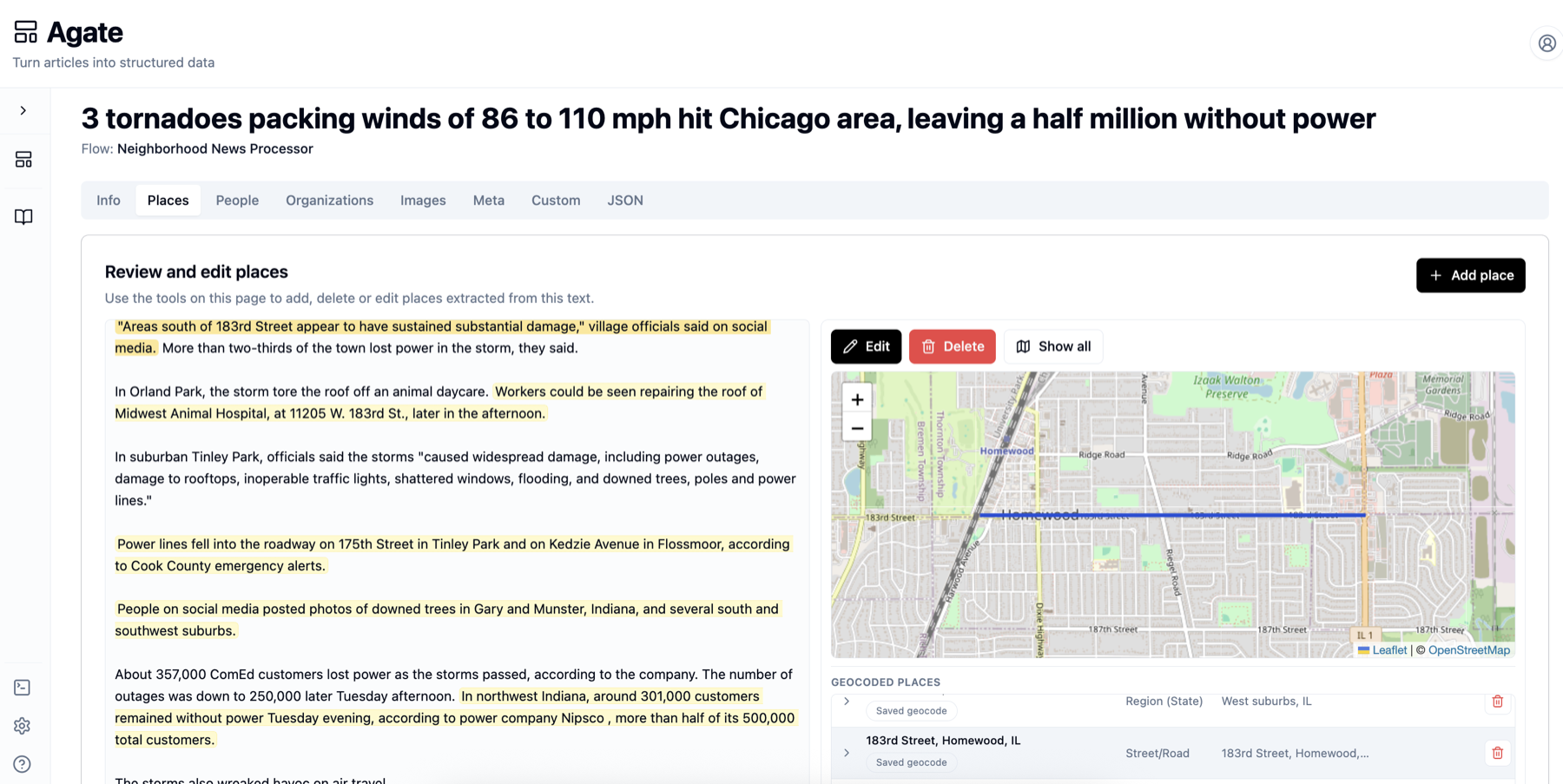
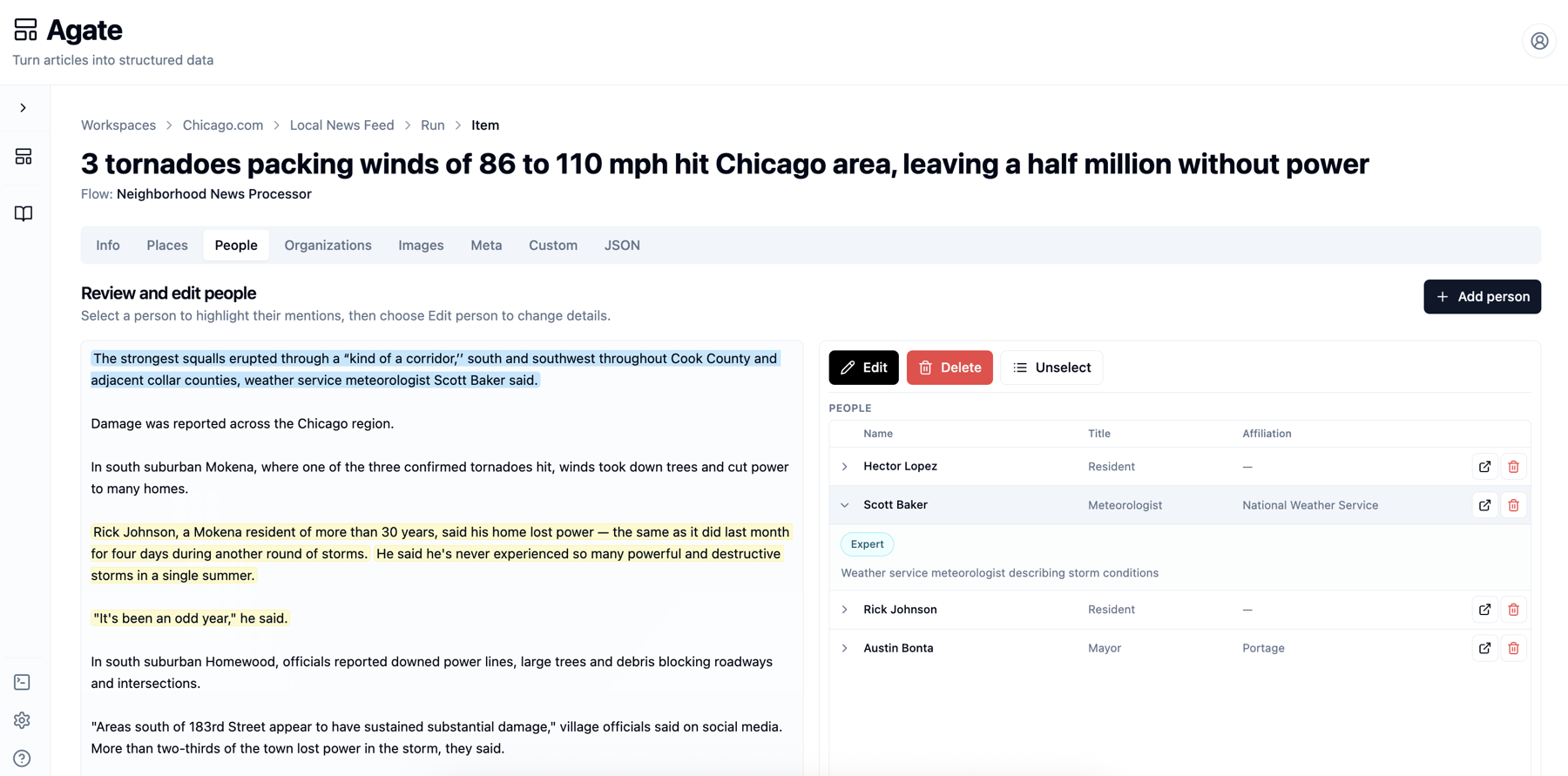
Identify people, places, organizations, quotes and events — or define custom extractions for things like recipes, obituaries and other story forms.
02
Enrich
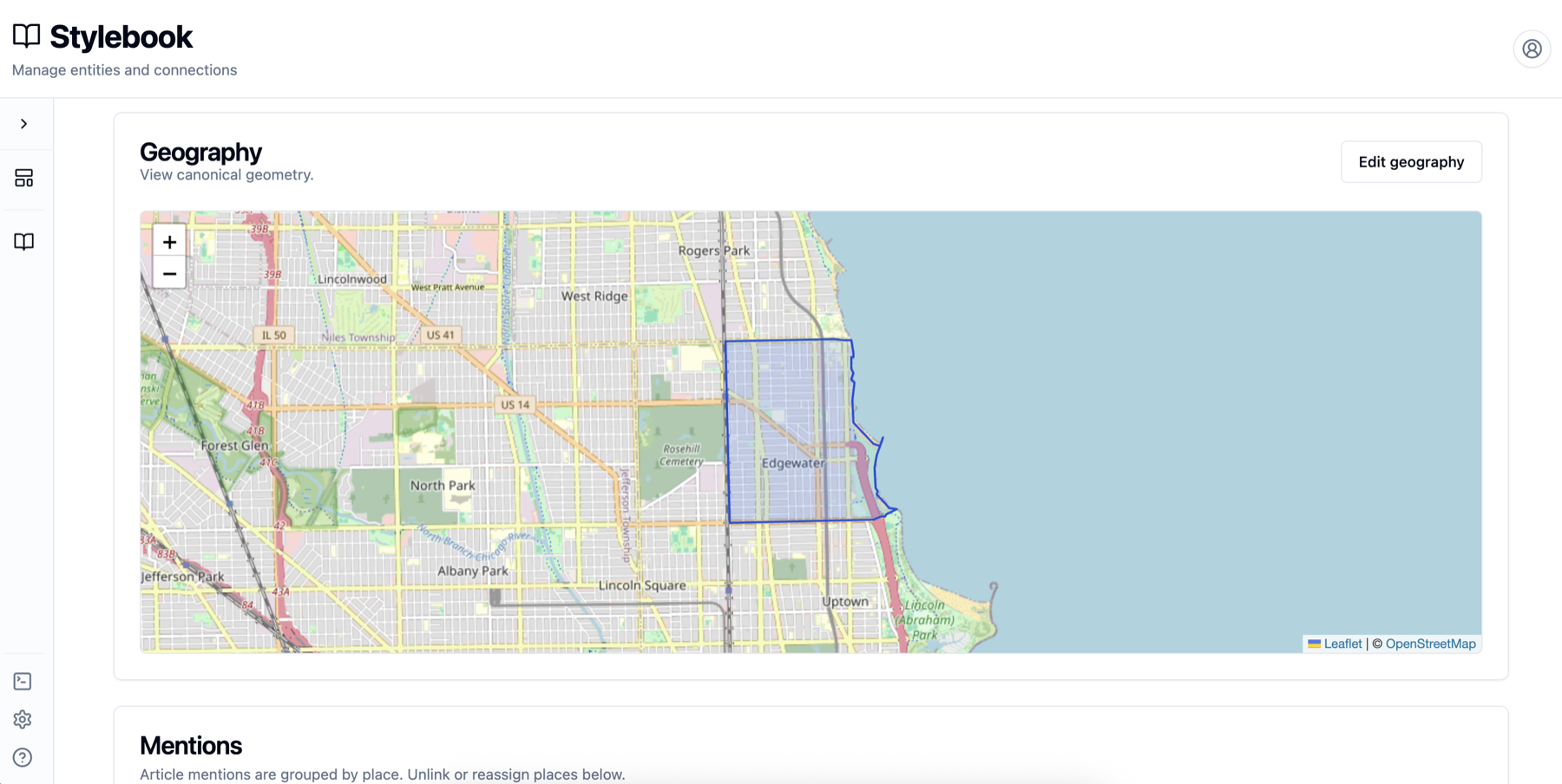
Geocode places, resolve entities to canonical records, attach geographic boundaries and add newsroom-specific context.
03
Describe
Classify stories based on subject, user needs, story forms and other custom taxonomies, then create embeddings to enable semantic search and similarity.
04
Build
Turn your coverage into data you can search, filter and build products around.
How it’s used
Get more from journalism
you already produce.
Local Angle has developed Backfield alongside working news organizations. The examples below show what becomes possible when the information within your journalism is made available as structured data.
Personalize your report
Create feeds for neighborhoods, suburbs and towns; build newsletters and other personalized experiences based on the people, places and institutions mentioned in your reporting.
Understand your coverage
Map your coverage, audit your sources, and see how your report might appear in the eyes of different communities you cover.
Turn narratives into interactives
Extract custom information from articles, such as ingredients from recipes, or restaurants from restaurant roundups, and use that data to build new products and story forms.
Give new life to your archives
Enable geographic, semantic and entity-based search across your archive; create a community knowledge graph that can inform your reporting.
Enrich your analytics
Add custom metadata like subjects, user needs and story forms to your articles, then use those to ask more nuanced questions about how your coverage performs.
Support new revenue
Tell your story to advertisers and funders, showing how your coverage intersects with their needs and interests.
See more experiments and examples in the Backfield Cookbook.
How it works
Backfield is three applications
Agate
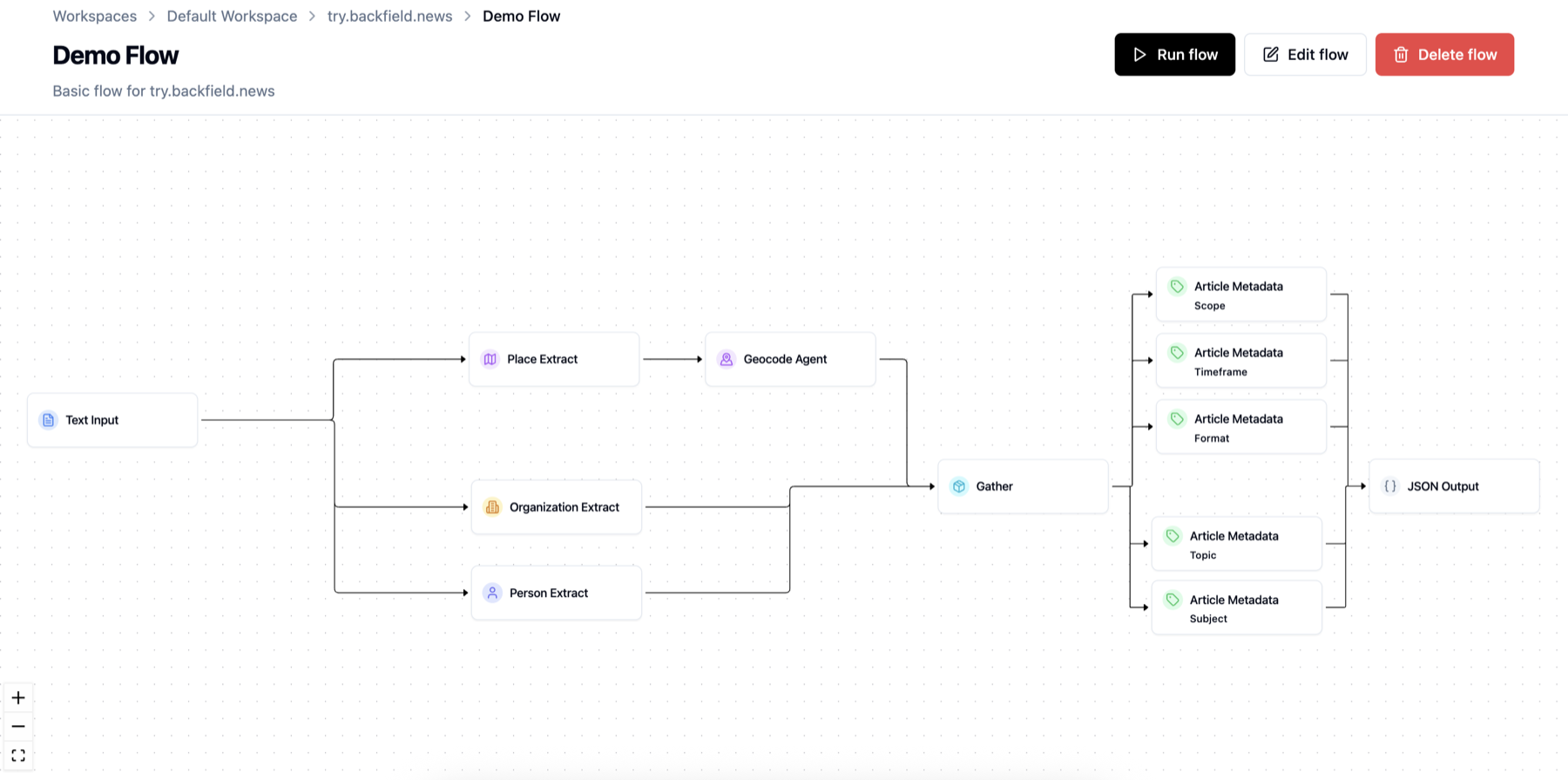
Build workflows that turn stories into structured data, with a suite of editorial review tools to keep humans in the loop.
Stylebook
Create, maintain, connect and enrich canonical records for the people, places and organizations featured in your coverage.
Backfield API
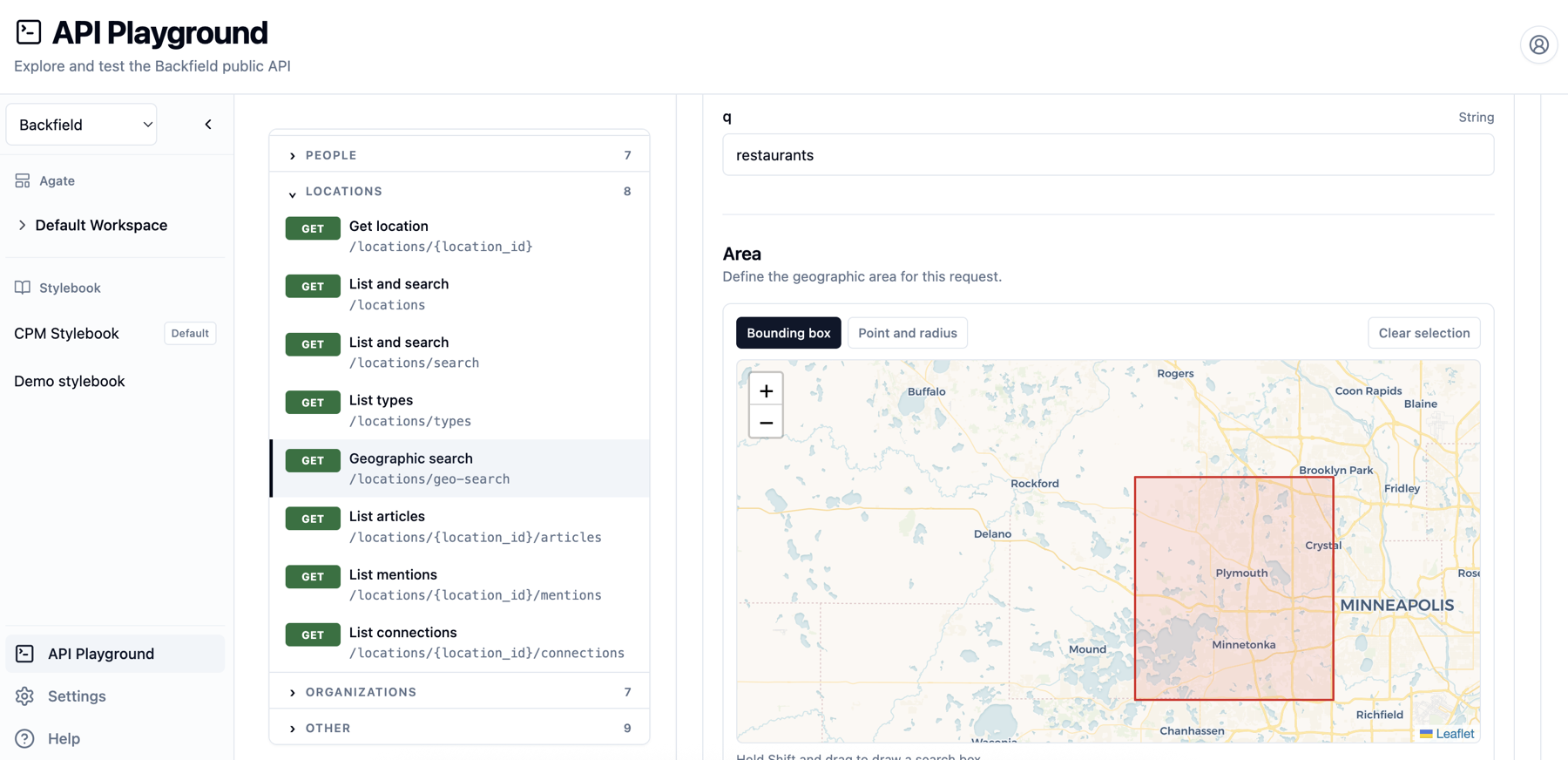
Query the resulting data to power newsroom tools, audience-facing products and other applications.
FAQ
Questions about Backfield
Who is Backfield for?
Backfield is for any news organization that wants to explore how structured journalism can benefit their business or their mission.
The platform is free to use under an Apache 2.0 license. If you don’t have engineering capacity or technical expertise, Local Angle offers several hosting options and is happy to work with you to build products based on the data you create.
For large organizations, Backfield is engineered to work at scale – capable of processing thousands of articles on dedicated and horizontally scalable infrastructure. You’re welcome to host it yourself, or Local Angle can do it for you.
How do I get started using Backfield?
Backfield is an open source platform, and you are welcome to run it locally or deploy it yourself by following the directions here.
Local Angle also offers hosting, onboarding and consulting services if you would like to run the platform without technical overhead. If you are interested in managed hosting, sign up for the waitlist.
Contact backfield@localangle.co if you have any questions.
Which models does it support?
Backfield is model-agnostic. Out of the box, it works with more than 3,000 models available via the LiteLLM ecosystem, including those from OpenAI, Anthropic, Google, xAI and popular open-weights alternatives. It can also be configured to use self-hosted or proprietary models.
What about privacy? Who gets access to our data?
Typically, processing an article through Backfield means sending its text, or portions of its text, through one more more large language models using those models' APIs.
Different models and model providers have different rules about the data they retain and how they use it. Many commercial model APIs explicitly do not use customer API data to train their models, but policies vary by provider and service.
Backfield uses LiteLLM, an open-source Python library, to communicate with supported model providers. LiteLLM runs within Backfield's infrastructure; article text is not routed through or stored by a LiteLLM-hosted proxy or other service.
One reason Backfield is model-agnostic is so that you can choose the appropriate model to balance your organization's needs for privacy, speed, accuracy and cost. We can work with you to choose the right models to meet your requirements.
Can there be journalists in the loop?
Absolutely. Like all automated systems, Backfield will make some mistakes — whether that’s geocoding a place incorrectly or tagging an article with metadata you might not agree with.
To what extent you choose to correct those mistakes depends on your product needs. The system generally does a pretty good job, and if you can tolerate some errors around the edges, you may decide you don’t need human review at all.
But Backfield data is at its best when it is at least occasionally reviewed by reporters and editors. There are a number of tools in the system designed to make that process quick and easy. And we can also do things like integrate with Slack to notify reporters and editors when there’s something they may want to check and correct.
The system gets faster and more accurate if you are able to maintain a clean and reliable Stylebook, so any effort you put into cleaning your data is paid back as time goes on.
At the end of the day, the level of human involvement you need is up to you.
How much staff time does it require?
Similar to the previous question, this depends on your product needs. After the initial setup, it is possible to run Backfield with no staff involvement at all.
However, spending a couple hours a week cleaning up and curating the Stylebook can pay huge dividends. At the very least, fixing obvious errors as you observe them is a good practice to adopt.
If you are interested in a more high-touch approach, the tools within Backfield should make it possible for a given reporter/editor to review and correct the data extracted from a single article in just a couple minutes.
How much does it cost to operate?
Backfield itself is open source, so there is no software license fee to run it yourself. Your costs are whatever infrastructure, model APIs and external services your workflows require.
Beyond your LLMs of choice, Backfield is considerably more accurate if you enable several external services. Specifically, Geocode Earth, Geocodio and Brave Search. These are not required, but they greatly improve results, especially around place extraction and geocoding.
For a mid-sized regional publisher processing 30–50 stories per day, costs for AI models, external geocoders and other services might typically run a few hundred dollars per month, depending on the workflows and models you choose.
Infrastructure costs vary widely depending on how you deploy Backfield. Lightweight deployments can be inexpensive; production systems requiring dedicated resources, redundancy, monitoring, backups and higher throughput will cost more.
Local Angle also offers managed hosting for organizations that don't want to deploy and operate the system themselves. Managed pricing includes the infrastructure as well as deployment, maintenance, monitoring, upgrades and support. Sign up to the waitlist if you are interested.
How do you load stories into Backfield?
Backfield can ingest stories in several ways. A dedicated full-text RSS or JSON feed is usually the simplest, but it can also scrape articles directly from your website or connect to another source you provide.
Does it work for things that aren’t journalism?
Yes, with some adaptation. Backfield is designed around the conventions and structure of news articles, so its default extractions, metadata and workflows are built with journalism in mind.
But the underlying system is flexible. With different prompts, schemas and workflows, Backfield has also been used to process civic information and other kinds of documents. If you have a use case outside journalism, we’d be interested in exploring it with you.